Recent Posts

    Authors

    Published

    Tag Cloud

    301 302 404 accessibility accounts ACLs advertising aggregation Agile Analytics android APP Article attachments awards backup BCM beta browser business continuity Calendar case-study categories Chrome citigroup cms codes coding standards Complaints contact management software control panel crm CSS customer management software customer relationship system customize database DataModel DDoS demo design designer device compatibility difference distribute a published article via email DND DNS documents drag & drop Editor email EOL erp event Excel featured feeds file manager file sharing file volume Firefox Firewall HA hack Handlebar how-to HTML HTML5 HTTP HTTPS iCal IE Instructions intranet iOS iPad Java JavaScript JDBC JDK Jenkins Job Track Journal JSON JVM landing-page launcher layered database layout logging login mac marketing menu meta Microsoft Outlook mobile module modules mustache navigation NTLM offline page painter password passwords PCI policy poll pricing privacy PROXY publish publisher publsher PWA redirect Redundancy release release-notes Report Tool Reports Responsive ReST RESTFul Rich text RSS Safari sandbox sanity schedule scrum search security SEO sessions setup shipping site builder source spell SQL Injection SSL SSO standards store stSoftware support survey Swagger Task template testimonial Threads timezone tinyMCE Transaction Search trigger twitter twitter bootstrap Ubuntu unit tests unsubscribe URL validation WC3 AAA web folders web services webdav windows 8 wizard workflow WYSIWYG XLS XLST XML XPath XSS

    Page META description

    The <meta description> tag contains a summary of the content which can be found on the page.

    The HTML META tag "description" allows you to influence how your web pages are described and displayed in search results. A good description acts as a potential organic advertisement and encourages the viewer to click through to your site.
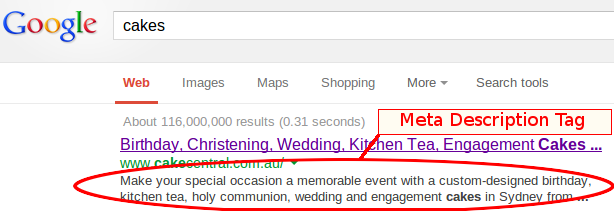
    Example META description

    A page META description should be short. The description in the <meta description> tag should to be between 25 and 160 characters in length. A <meta description> tag which is too long will be displayed truncated and can be seen as spam by search engines. The optimal length is at least 70 characters.

    Validation Warning: Page 'example' SHOULD have a relevant META description.
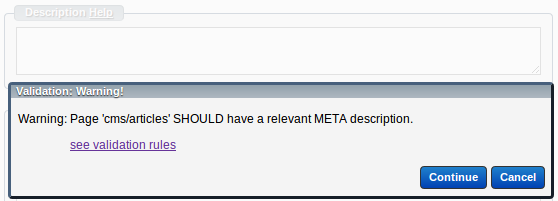
     Blank description validation

    Validation Warning: Page 'example' should have a short META descrtion.
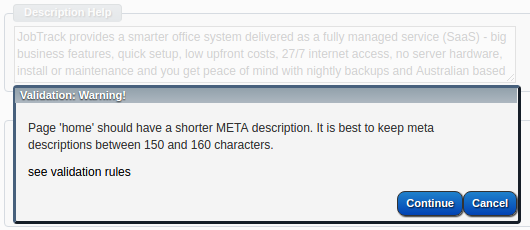
    Long description validation

    To optimize for search engines. it is important that the keywords for a given page in the META description are written in a 'natural' way - complete sentences that are understandable and pleasant for the searchers and would-be site visitors to read. This is especially important since many search engines display the description in their search results. 

    It's important that every page has it's own relevant META description. Every page has it's own unique content and therefore must have it's own unique META description. Incorporate a maximum of five keywords in every description for which the page is to be optimized. These keywords must also occur in the text on the page.

    Validation Warning: META description should NOT be duplicated.
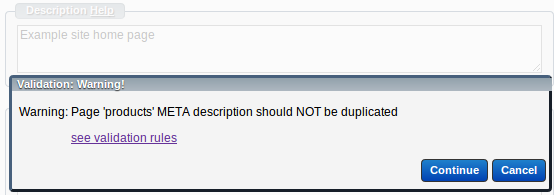
    Duplicate description warning 

    Note:-

    • If the page includes an "Article" then the description of the article will be used and thus no warning required.
    • Double quotes should not be included in a description and are automatically replaced with a single quote.

    References:-